
Correct vial preparation begins with understanding the material you are working with. From choosing the appropriate diluent to recording the final concentration, each stage helps support consistent handling and reliable research.
At Everform, we believe that clear information is an essential part of responsible research. The foundation of correct preparation is to follow validated instructions for the specific product, rather than applying one method to every peptide.
This article explains general laboratory handling principles. Everform products are supplied for laboratory research only and are not intended for human or veterinary administration.
Understanding Peptide Vial Preparation
By Everform Pharma
1.
What is reconstitution.
Many peptides are supplied as lyophilised, or freeze-dried, powders. Reconstitution is the process of adding a suitable liquid, called a diluent, to dissolve the powder and produce a solution.
Although the principle is straightforward, the requirements can vary between compounds and formulations. The appropriate diluent, liquid volume, mixing method and storage conditions must be confirmed before preparation begins.
2.
Start with the vial and its documentation
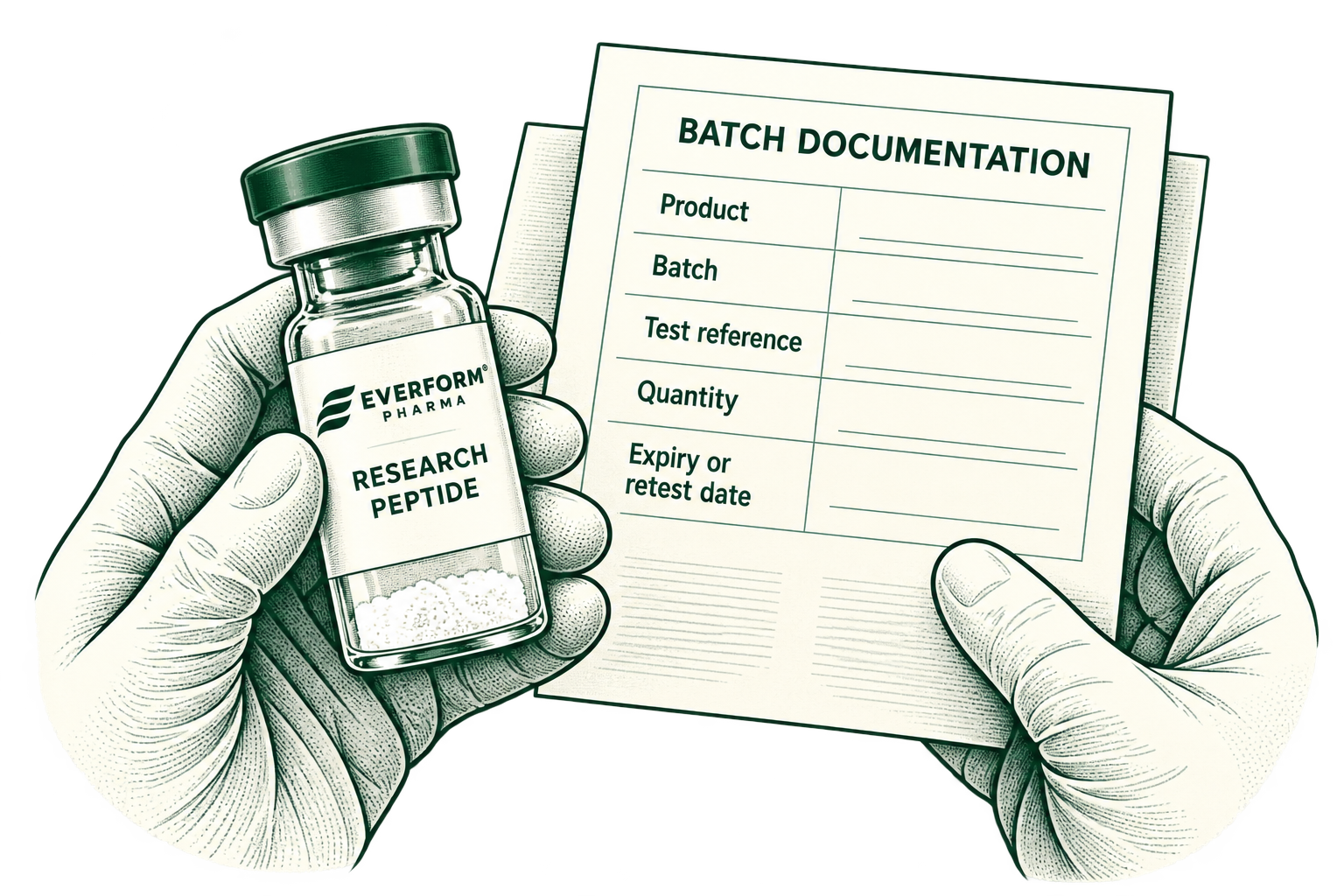
Before preparing a solution, check the product name, labelled quantity, batch number and expiry or retest date, where provided. Inspect the vial and closure for damage, leakage or signs that the seal has been compromised.
Review the available technical documentation for solubility, compatibility and handling requirements. A certificate of analysis can provide information about the tests performed on a batch, but its meaning depends on the scope of those tests.
Identity and purity results alone do not establish sterility, endotoxin levels or suitability for injection.
3.
Choose the appropriate diluent
The liquid used for reconstitution must be compatible with the particular product and the intended laboratory method. Water, buffered solutions and other solvents are not interchangeable.
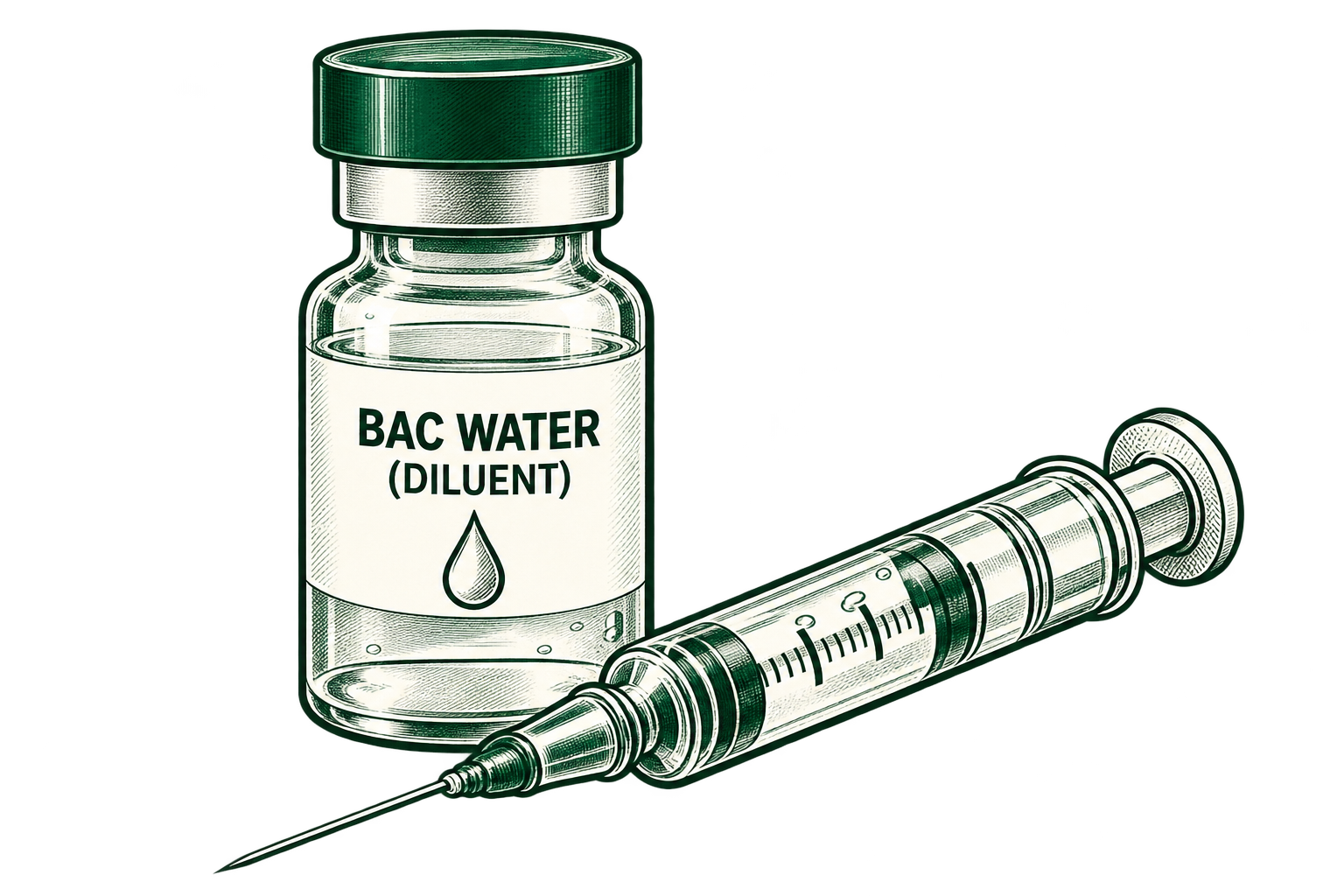
Bacteriostatic water, sometimes called “BAC water”, contains a preservative, commonly benzyl alcohol, that helps inhibit bacterial growth. However, its preservative does not sterilise contaminated material, and its presence may affect compatibility with a particular compound or research assay.
Use bacteriostatic water only where the relevant preparation instructions and research protocol support its use. Instructions for bacteriostatic water itself direct users to the product manufacturer’s guidance when selecting the diluent and reconstitution volume. [1]
4.
Understand the final solution volume
The amount of peptide and the final volume of the prepared solution determine its concentration. Adding more diluent produces a lower concentration; adding less produces a higher concentration, provided the material dissolves fully.
The volume of diluent added and the final prepared solution volume are not necessarily identical. Where accurate concentration matters, follow the validated method for achieving or determining the final volume rather than assuming that the two measurements are interchangeable.
Concentration is calculated by dividing the amount of dissolved material by the final solution volume. When the amount is expressed in milligrams and the volume in millilitres, the resulting concentration is expressed in milligrams per millilitre, or mg/mL.
Keep mass, volume and concentration clearly distinguished throughout preparation. A vial’s nominal capacity describes the container, not the amount of liquid that should be added.
5.
Prepare a clean working area
Organise the workspace before opening or accessing any materials. Use suitable laboratory hygiene, appropriate protective equipment and measuring equipment that can accurately handle the required volume.
Where a vial is accessed through a rubber stopper, disinfect the stopper and allow it to dry. Avoid touching disinfected surfaces or parts of the equipment that must remain sterile.
Use a new, sterile needle and syringe for each vial entry where these are used, and dispose of sharps in an appropriate container. Reusing equipment can introduce contamination. [2]
6.
Mix gently following the specified method
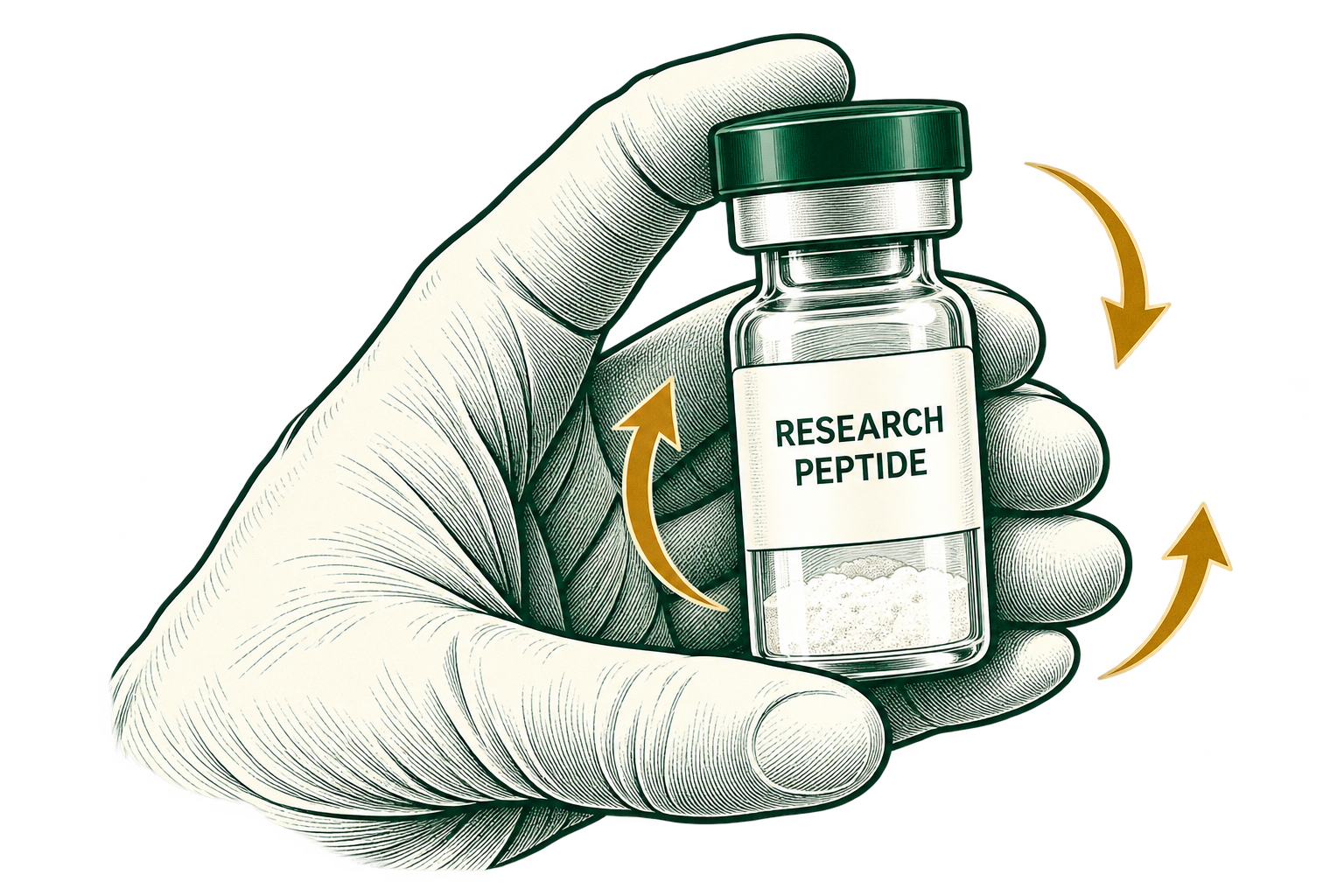
Where product instructions recommend gentle addition, introduce the diluent slowly down the inside wall of the vial. Allow time for the material to dissolve, using gentle swirling or another specified mixing method.
Avoid vigorous shaking unless the validated preparation method calls for it. Some formulations can be affected by agitation, foaming or aggregation, but it is inaccurate to claim that shaking automatically breaks peptide bonds or destroys every peptide.
Temperature requirements are also product-specific. Do not assume that every vial must reach room temperature before reconstitution, or use external heat to speed dissolution without supporting instructions.
7.
Inspect the prepared solution
Once preparation is complete, compare the solution with its documented expected appearance. Unexpected particles, cloudiness, precipitation or changes in colour should be investigated before the material is used in research.
Not every peptide solution is naturally colourless. The relevant comparison is with the specification for that particular product.
Visual inspection can identify some problems, but a clear solution does not prove sterility, purity or stability. Appearance should be assessed alongside preparation records and the applicable quality requirements.
8.
Label the vial clearly
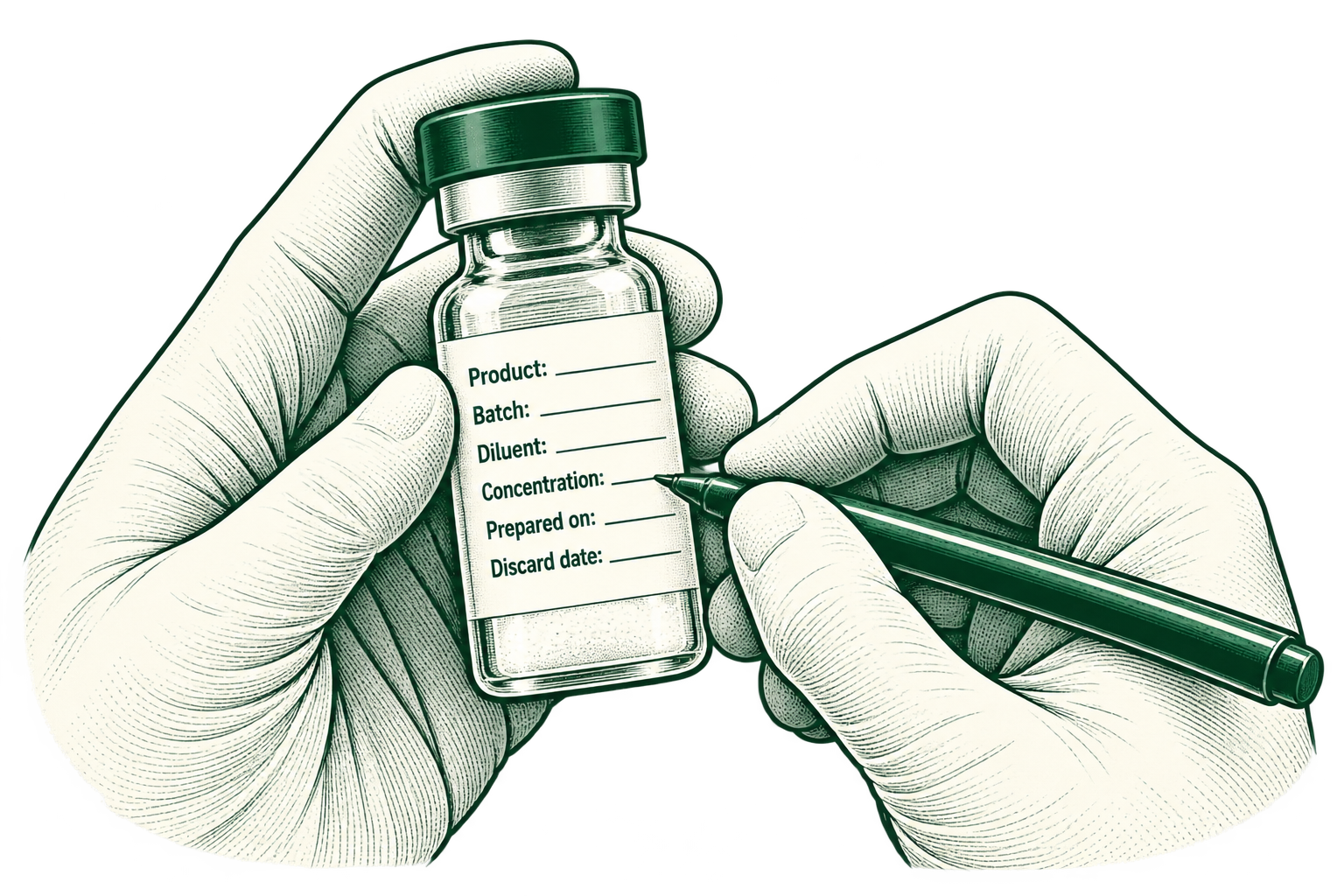
A prepared solution should be identifiable without relying on memory. Record the product name, batch reference, diluent, concentration, preparation date and applicable storage or discard instructions.
Label the final concentration, not simply the amount of liquid added. This makes subsequent measurements easier to interpret and helps reduce confusion between the original vial contents and the prepared solution.
9.
Follow product specific storage instructions
Storage requirements can change after reconstitution. Conditions suitable for a freeze-dried powder may be unsuitable for the same material in solution.
Follow the documented requirements for temperature, light protection and permitted storage duration. Refrigeration, freezing and repeated freeze–thaw cycles should be considered only where supported by the relevant stability information.
Bacteriostatic water does not automatically give a reconstituted peptide a 28-day shelf life. The commonly cited 28-day recommendation applies to opened multidose vials unless the manufacturer specifies otherwise; it does not establish the chemical stability or usable life of every solution prepared with that water. [3]
At Everform, our approach to preparation centres on clear documentation, compatible materials, accurate measurements and careful handling. Understanding these principles helps researchers prepare solutions consistently while recognising where product-specific instructions are essential.
Sources
[1] DailyMed. Bacteriostatic Water for Injection USP. Manufacturer labelling.
View manufacturer labelling on DailyMed
[2] CDC. Safe Injection Practices to Prevent Transmission of Infections to Patients.
https://www.cdc.gov/injection-safety/hcp/clinical-guidance/
[3] CDC. Preventing Unsafe Injection Practices.
https://www.cdc.gov/injection-safety/hcp/clinical-safety/